Compare chunk overlap with a small retrieval fixture
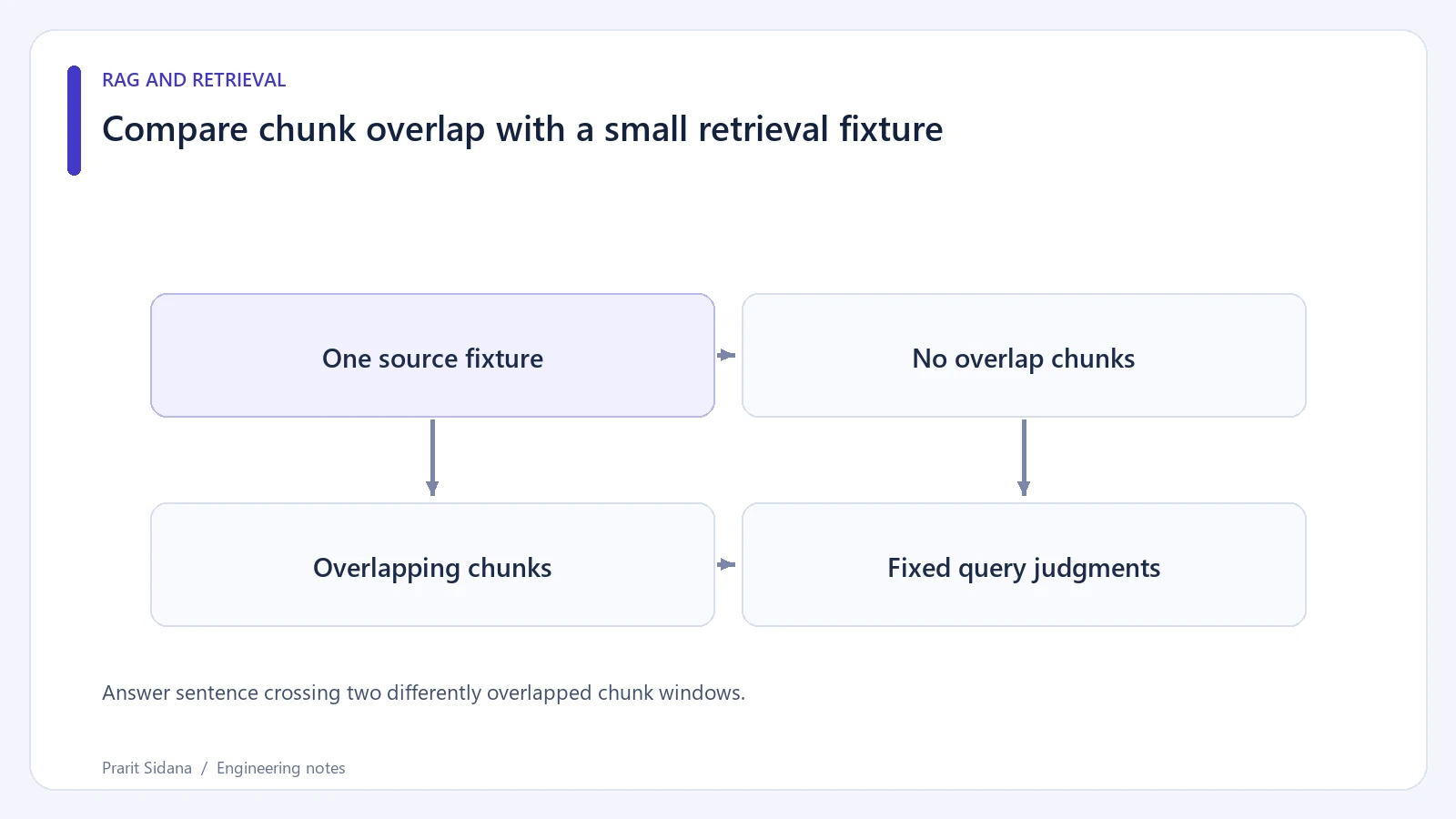
Overlap duplicates some text between neighboring chunks so information near a boundary has another chance to appear together. It also increases stored text and can fill the top results with near-duplicate passages. Choose it with a small labeled fixture before applying it to the whole corpus.
Write a synthetic paragraph where the answer spans two sentences. For example, one sentence introduces an export job and the next explains when its download expires. Add unrelated paragraphs before and after it. Keep the source and the question identical while changing the chunking configuration.
Compare a no-overlap setting with two modest overlap sizes that suit the chosen unit. Record whether sizes count characters, words or tokenizer tokens. A number without that unit cannot be reproduced.
Answer sentence crossing two differently overlapped chunk windows.
Compare support, not only matching words
For each configuration, inspect the first few retrieved chunks. Mark whether one passage contains enough information to answer the expiration question. Finding the word "export" is insufficient if the sentence with the expiry rule was cut away.
Also record unique source spans in the top results. If five returned chunks all contain the same duplicated sentence, the interface has less useful coverage than five visually separate result cards suggest. Deduplicating overlapping candidates before assembling context may preserve space for other relevant sections.
The semantic-search documentation explains retrieval over embedded corpus entries. Retrieve and rerank documentation describes a later candidate-ranking stage. Neither stage can reconstruct source text that the chunking process discarded.
Keep the comparison controlled
Use the same query set, embedding configuration and retrieval limit for every run. Save chunk IDs and their exact text alongside the judgments. If the tokenizer or model changes between runs, a different result may have several causes.
Include a question that needs a compact passage and another that needs two adjacent sections. More overlap can help the first boundary case while making the second harder by using the context budget on repetition. Keep the failure examples visible when selecting a default.
This is an experiment plan, not a measured recommendation for a particular overlap percentage. No retrieval model was run for the synthetic example. A hand inspection can reveal broken boundaries, but a larger representative evaluation is needed before claiming an improvement.
If one heading-based split preserves the complete procedure naturally, it may remove the need for extra overlap at that boundary. Use duplication where it helps a demonstrated retrieval problem and account for its storage, embedding and context costs.